


|
|
|
Forty-five years ago in a CIA project so important and secret that their identities were not publicly revealed by the CIA until the past year, a group of young Air Force pilots volunteered to be 'sheepdipped' from the Air Force to the Central Intelligence Agency to fly an unidentified aircraft at an undisclosed venue to replace the U-2 conducting reconnaissance flights over the denied territories of our Cold War enemies. These pilots were among a total of only 16 surviving a secret and highly selective vetting of the top pilots from within our nation's armed forces. For years they used puesno names and resided Monday through Friday at a secret, remote site only 85 miles from their families, yet they were unable to tell even their families where they worked or what they were doing. Much of what they did will never be told in the interest of national security. These were the pilots of the CIA's Project OXCART and Operation BLACK SHIELD. These are the pilots who pioneered sustained flight in excess of Mach 3 at altitudes exceeding 90,000 feet. These are the pilots who flew and wrote the flight manuals for a new class of high speed aircraft hand built from materials invented as needed, a plane that flew so hot that it required wiring, sealants, fuels and lubricants yet to be invented.
During the flight phases of Project OXCART, 2,850 flights were completed for a total of 4,800 flight hours. There were 1,032 flights which reached or exceeded speeds of Mach 3.0 for a total of 675 flight hours at or above Mach 3.0. The maximum speed achieved was Mach 3.29. The maximum altitude achieved was 90,000. The longest single flight was 7:40 hours. On another flight, 3:50 hours were spent at or above Mach 3.0. The longest single sustained flight time at or above Mach 3.2 was 1:14 hours. During the last three years of OXCART, Mach 3.0 flights were made on a routine daily basis. The most advanced aircraft of the 20th century became an anachronism before it was ever used operationally.
Twenty-nine operational missions were flown in Operation Black Shield. Twenty-four were flown over North Vietnam, two were primarily targeted against Cambodia, and three were over North Korea. The cameras operated satisfactorily, and good to excellent imagery was obtained. Enemy radar tracking was reported on all but two missions, ranging from brief reflections of the A-12's presence to extended and accurate tracking. Surface to air missiles were launched at the A-12 on three missions, without success.
Five A-12s were lost due to accidents. Two A-12 pilots were killed, Walter Ray at Groom Lake and Jack Weeks at Kadena. Two chase plane pilots were lost, Lt. Col. Jim Simon at Groom Lake and Lt. Col. Welton King at Kadena. Jack Weeks piloting the fifth accident in the OXCART program was lost on 4 June 1968 when an aircraft disappeared without a trace east of the Philippines while on a routine functional check flight following an engine change. Cause of the accident was not determined, although catastrophic engine failure was possible based on analysis of malfunction sensing signals received immediately preceding the aircraft's disappearance. An intensive sea and air search failed to locate the pilot, aircraft or any evidence of the accident. The other two A-12s left OKINAWA ON 8 and 19 June 1968. OXCART facilities at Kadena were turned over to the USAF for use by the SR-71 detachment. Frank Murray made the final flight of an A-12 in Article 131 on 21 June 1968 from Groom Lake to the storage at Palmdale. On June 1968 OXCART closed shop with the BLACK SHIELD pilots being awarded the CIA Intelligence Star for Valor.
Click on the Mission # for more information and related mission documents
| Mission # | Date | Pilot | Aircraft # | Target | Notes | |
| BSX-001 | 31 May 1967 | Mele Vojvodich | #131 | North Vietnam | Mission was flown at Mach 3.2 and 80,000 feet for a duration of 3:55 hours. Imagery quality was good to excellent. | |
| BSX-003 | 10 Jun 1967 | Jack Weeks | #131 | North Vietnam | Mission was flown at Mach 3.17 and 82,000 feet for a duration of 4:58 hours. Imagery quality was excellent. | |
| BX6705 | 20 Jun 1967 | Jack Layton | #129 | North Vietnam | Mission was flown at Mach 3.17 and 82,000 feet for a duration of 4:58 hours. Imagery quality was excellent. | |
| BX6706 | 30 Jun 1967 | Jack Weeks | #129 | North Vietnam | Mission was flown at Mach 3.17 and 82,000 feet for a duration of 4:58 hours. Imagery quality was excellent. | |
| BX6708 | 13 Jul 1967 | Ken Collins | #127 | North Vietnam | Mission was flown at Mach 3.15 and 82,100 feet for a duration of 3:40 hours. Imagery quality was good. | |
| BX6709 | 19 Jul 1967 | Dennis Sullivan | #131 | North Vietnam | Mission was flown at Mach 3.17 and 82,000 feet for a duration of 4:58 hours. Imagery quality was excellent. | |
| BX6710 | 20 Jul 1967 | Ken Collins | #129 | North Vietnam | Mission was flown at Mach 3.16 and 82,450 feet for a duration of 4:55 hours. Imagery quality was good despite haze problem. | |
| BX6716 | 21 Aug 1967 | Mele Vojvodich | #131 | North Vietnam | Mission was flown at Mach 3.17 and 82,000 feet for a duration of 4:58 hours. Imagery quality was excellent. | |
| BX6718 | 31 Aug 1967 | Jack Layton | #127 | North Vietnam | Mission was flown at Mach 3.20 and 81,000 feet for a duration of 5:12 hours. Imagery quality was good until camera malfunctioned. | |
| BX6722 | 16 Sep 1967 | Jack Weeks | #129 | North Vietnam | Mission was flown at Mach 3.15 and 80,000 feet for a duration of 4:01 hours. Imagery quality was good. | |
| BX6723 | 17 Sep 1967 | Ken Collins | #131 | North Vietnam | Mission was flown at Mach 3.16 and 81,000 feet for a duration of 4:00 hours. Imagery quality was excellent. | |
| BX6725 | 4 Oct 1967 | Ken Collins | #127 | North Vietnam | Mission was flown at Mach 3.14 and 81,000 feet for a duration of 4:09 hours. Imagery quality was excellent. | |
| BX6727 | 6 Oct 1967 | Frank Murray | #131 | North Vietnam | Mission was flown at Mach 3.19 and 81,000 feet for a duration of 2:20 hours. Imagery quality was good. Mission was prematurely terminated due to a faulty oil pressure indicator. | |
| BX6728 | 15 Oct 1967 | Ken Collins | #131 | North Vietnam | Mission was flown at Mach 3.19 and 81,000 feet for a duration of 3:41 hours. Imagery quality was good. | |
| BX6729 | 18 Oct 1967 | Frank Murray | #129 | North Vietnam | Mission was flown at Mach (classified) and 81,000 feet for a duration of 4:01 hours. Imagery quality was good. | |
| BX6732 | 28 Oct 1967 | Dennis Sullivan | #131 | North Vietnam | Mission was flown at Mach 3.15 and 83,500 feet for a duration of 3:49 hours. Imagery quality was good. | |
| BX6733 | 29 Oct 1967 | Frank Murray | #127 | North Vietnam | Mission was flown at Mach (classified) and 82,000 feet for a duration of 3:56 hours. Imagery quality was good. | |
| BX6734 | 30 Oct 1967 | Dennis Sullivan | #129 | North Vietnam | Mission was flown at Mach 3.20 and 85,000 feet for a duration of 3:44 hours. Imagery quality was good. | |
| BX6737 | 8 Dec 1967 | Mele Vojvodich | #131 | Cambodia & Laos | Mission was flown at Mach 3.20 and 82,500 feet for a duration of 3:59 hours. Imagery quality was excellent. | |
| BX6738 | 10 Dec 1967 | Jack Layton | #131 | Cambodia & Laos | Mission was flown at Mach 3.17 and 81,000 feet for a duration of 3:51 hours. Imagery quality was good. | |
| BX6739 | 15 Dec 1967 | Mele Vojvodich | #127 | North Vietnam | Mission was flown at Mach 3.20 and 86,000 feet for a duration of 4:09 hours. Imagery quality was good. | |
| BX6740 | 16 Dec 1967 | Jack Layton | #131 | North Vietnam | Mission was flown at Mach 3.20 and 86,200 feet for a duration of 3:56 hours. Imagery quality was good. | |
| BX6842 | 4 Jan 1968 | Jack Layton | #127 | North Vietnam | Mission was flown at Mach 3.20 and 85,100 feet for a duration of 3:57 hours. Imagery quality was good. | |
| BX6843 | 5 Jan 1968 | Jack Weeks | #131 | North Vietnam | Mission was flown at Mach (classified) and 86,000 feet for a duration of 4:09 hours. Imagery quality was satisfactory (haze and cloud shadow). | |
| BX6847 | 26 Jan 1968 | Jack Weeks | #131 | North Korea | Mission was flown at Mach 3.20 and 83,500 feet for a duration of 4:00 hours. Imagery quality was good. | |
| BX6851 | 16 Feb 1968 | Ken Collins | #127 | North Vietnam | Mission was flown at Mach 3.20 and 85,600 feet for a duration of 3:54 hours. Imagery quality was good (considerable cloud coverage). | |
| BX6853 | 19 Feb 1968 | Frank Murray | #127 | North Korea | Mission was flown at Mach 3.20 and 83,500 feet for a duration of 3:39 hours. Imagery quality was good. | |
| BX6856 | 8 Mar 1968 | Mele Vojvodich | #127 | North Vietnam | Mission was flown at Mach 3.20 and 85,500 feet for a duration of 4:01 hours. Imagery quality was good. | |
| BX6858 | 6 May 1968 | Jack Layton | #127 | North Korea | Mission was flown at Mach 3.20 and 84,700 feet for a duration of 3:30 hours. Imagery quality was fair due to haze and scattered clouds. |
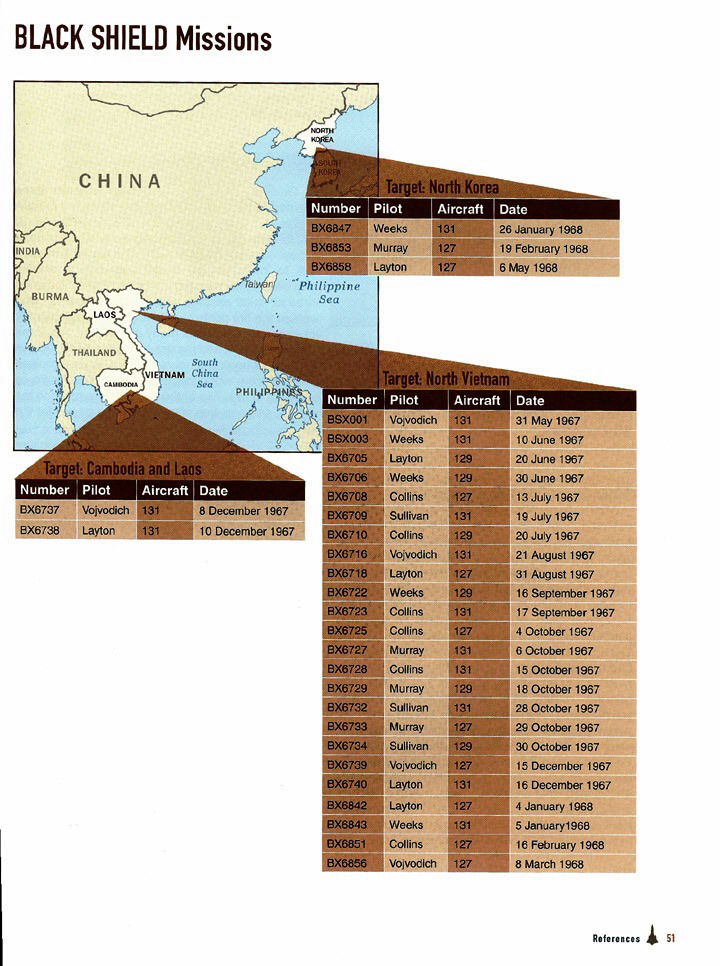
Image credited to Archangel - CIA's Supersonic A-12 Reconnaissance Aircraft by David Robarge
 |
 |
 |