


|
|
|

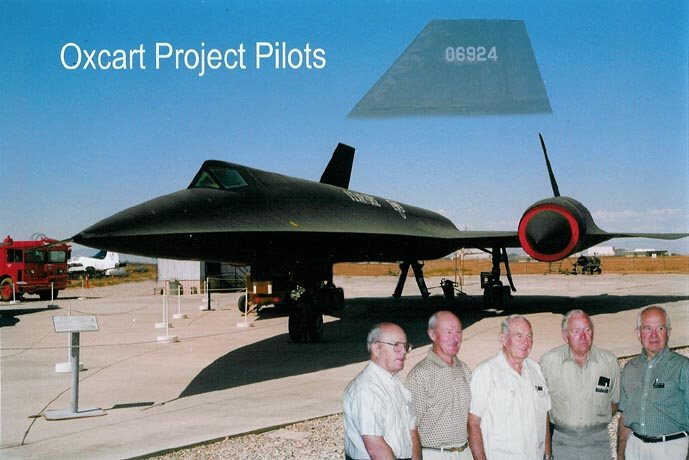
The five remaining Agency A-12 Pilots (Code-named "Drivers")
Mele Vojvodich, Denny Sullivan, Jack Layton, Frank Murray, Ken Collins
Photo courtesy of Roadrunner Mike Schmitz

EPILOGUE
CIA pilot Jack Weeks was killed over the Pacific Ocean as he tested engine repairs to one of the planes just prior to the A-12's being returned from Kadena, Okinawa to Area 51 for retirement.
CIA pilot Walter Ray was killed during testing of the A-12 at Groom Lake
OXCART PILOT QUALIFICATIONS
Project OXCART had to be of quite extraordinary competence, not only because of the unprecedented performance of the aircraft itself, but also because of the particular qualities needed in men who were to fly intelligence missions. Pilots had to be qualified in the latest high performance fighters, emotionally stable, and well motivated. They were to be between 25 and 40 years of age, and the size of the A-12 cockpit prescribed that they be under six feet tall and under 175 pounds in weight.
Surviving the screening of Air Force files, psychological assessments, physical examinations and refinement of criteria, the pilots were selected to undergo intensive security and medical scrutiny by the Agency before being approached to take employment with the Agency on a highly classified project involving a very advanced aircraft. When the final screening was complete, the pilots selected from the program were William L. Skliar, Kenneth S. Collins, Walter Ray, Alonzo Walter, Mele Vojvodich, Jack W. Weeks, Ron "Jack" Layton, Dennis B. Sullivan, David P. Young, Francis Murray, and Russell Scott. In November 1961, commitments were obtained from the group and arrangements made with the Air Force to effect appropriate transfers and assignments to cover their training and to lay the basis for their transition from military to civilian status. Compensation and insurance arrangements were similar to those for the U-2 pilots.
Project OXCART, A-12 CIA Induction
By CIA PILOT KEN COLLINS
The primary professional selection criteria were century series fighter-type aircraft. The pilot had to have more than 1000 operational flight hours in the century aircraft and a total of 2000 flight hours. He had to be currently qualified and proficient in a current fighter-type aircraft. At that time I was an experienced instructor pilot in the RF-101 having had over fifty air to air refueling training sorties and about ten transatlantic deployments each with multiple air-air refuelings. This was the easy part for the Pentagon selection group. Either you had it or you didn"t. The requirements that you were highly qualified as an officer and a pilot were basic"an absolute minimum. All of your flight, professional and medical records were meticulously scrutinized at all levels before your name was released for further evaluation.
The initial personal requirement was that you had to be married and preferably that you had children. They were adamant about this after the problems that they experienced with the previous U-2 program. Their explanation for this was that the family unit is more socially established, dedicated and dependable. All of our wives were also interviewed separately and psychological evaluations were conducted. Expanded background investigations were run on them also.
At this phase (April 1961) of the overall evaluation we did not know for what we were being evaluated. The following events and schedules were generally the same for all of the pilots being considered. Each was individually and separately tasked for the respective events. I initially did not know that there was another pilot (Captain Walter Ray) from Shaw AFB,SC. We started running into each other about a year later when the field of consideration was narrowed by elimination. From the beginning you were given the option of withdrawing from the selection at any time without prejudice. This option continued throughout the program.
Our medical records were acceptable for an initial evaluation, because we were all on flying status. They were not extensive enough and we were about to find out what that really meant. I was scheduled for my"astronaut" physical at the Lovelace Clinic in Albuquerque, New Mexico. This is the same facility that the original astronauts received their medical evaluations. It was also the medical facility for the original U-2 pilots. I discovered this after I ran into and met Francis Gary Powers at the clinic. The Lovelace Clinic was founded by Dr. Lovelace (Deceased) who was one of the pioneers of aviation medicine. His work was continued by his son, Dr. Randy Lovelace, until he, his wife and their pilot was killed flying into a mountain west of Colorado Springs.
I had a government contact (an Air Force flight surgeon) that I met at the clinic. He established all of my schedules and appointments and observed all of the tests. He and I would have dinner together more as a part of the evaluation than just being social. The first medical phase lasted for five days; arriving there on Sunday and departing the following Saturday. In those five days they checked out every bodily orifice, X-rayed every part of you from head to toe, flushed you out totally, took samples and measured everything (I carried a large brown bottle around for 48 hours to collect every drop of urine). They conducted extensive EKGs and EEGs. I was hydrostatically weighed in the large water tank, ran the bicycle pulmonary functions and passed other physical stress exercises. I was then flown me Los Alamos Laboratory to be inserted into the"body counter", which mapped the fat versus muscle tissue of the body. When correlated with the data from the hydrostatic weighing, theoretically they determined the total body capacity, regardless of size. After all of that I was ready for the hospital.
From this date forward, I was subjected to many different kinds of personal and professional evaluations. There was the sound proof black box where you had to remain for twelve hours"total darkness; sleepless in Philadelphia and the polygraph. Various dinners and/or lunches with a whole variety of "professional" people, medical people and intelligence People, ranging from the senior managers to the basic company employee. All were there to get an opinion, except the lesser guy. He was there to keep me out of trouble.
After the sorting was near completion, I learned that there would 8 selected for the initial program. This sounded reasonable, since that was the average group for the astronaut Program.
I finally received my orders assigning me to the Headquarters, USAF, Pentagon with a reporting date of 28 October 1962. In fact, the day the movers were finishing packing me and we were driving out the next day, I received a call from Lt. Colonel Clyde East, who was my squadron commander (20th Tactical Reconnaissance Squadron, Shaw AFB, SC). He said that I was to report to the base immediately, because the RF-101s were on alert for immediate deployment (to MacDill AFB, FL for the Cuban Crisis).
Obviously, I was not available for the deployment although I would have liked to have gone with the squadron. The week before I departed Shaw AFB, SC, I was again called to Washington D.C. for a final meeting at which time you still had the option to withdraw from the program. I was told that it was not the astronaut program, but a project to fly and test an exotic new airplane for the Central Intelligence Agency. Still there was no pictures or any other details. I then met Bill Skliar, Lon Walter and I already knew Walt Ray from Shaw. (Note: Lon Walter resigned after a couple of flights in March 1963, Bill Skliar was killed in his racer in Reno, NV after he retired and Walt Ray was killed during an A-12 ejection in 1966). I was told that I was to be in LA by November 1962 and further instructions and contacts would follow when I got there.
I arrived in Washington D.C. with Jane and the four children. The next day I was taken to headquarters to sign on the dotted line. We headed West the following day. Jane was interviewed and evaluated during this process. That was done separately from me. She was not told what I would be doing and she was not to talk about it to anyone. She could say that I decided to resign from the Air Force and to work for Hughes Aircraft. ( For all who thought we received a great salary, we all made about $4000.00 per year more than our then current Air Force pay, but the job was well worth it.)
The first time I saw the A-12 or even heard the name was in December 1962 after I arrived at Area 51. Colonel Doug Nelson, Project Operations Officer, took me to the hangar and let me walk in by myself. What an amazing sight! There were no hangar lights. The sunrays entered the upper hangar windows illuminating only the nose and the spikes. As your eyes adjusted to the restricted light, you began to take in its sleek length, the massive twin rudders and its total blackness. A vision that will never be forgotten.
Ken Collins, Dutch 21
(Project OXCART, A-12, Pilot Training)
By: CIA PROJECT PILOT KEN COLLINS
Most are familiar with the military term"R&R" (Rest & Recreation). For the family it has a totally different connotation. For them it reassignment and relocation and a lot of work. The Air Force life had many positive aspects and usually they benefited both the Air Force and the military member and his family. The squadron assigned you a fellow officer to assist you and your family in getting settled and familiar with the new base and the local area. Housing was essential for the family prior to settling into the new job. This job was as a civilian working as a flight test pilot/consultant to Hughes Aircraft Company, but they only assisted you with the job administration. For housing and the family I was on my own.
Coming from little country Sumter, South Carolina to a mega-metropolitan area like Los Angeles for the first time was something else. Jane and I and our four children departed Sumter, SC via Washington D.C. making relative"pit stops" in Memphis, Tennessee and San Angelo, Texas, and from there to Long Beach, California. This was the only city in California that I had ever visited. I had flown to the Long Beach airport in 1951 in a B-25 Trainer out of Vance AFB, OK with my instructor, Captain Cook, and my flight classmate, Chuck Costantino. We were there two days and flew back to Oklahoma. The family and I were there only two days, also. After talking to Walt Ray, another project pilot, we moved to the San Fernando Valley. This at the suggestion of Clay Lacy, a pilots training classmate and friend of Walt Ray. Clay Lacy was then a pilot for United Airlines and now owns Clay Lacy Charter, a very successful air charter company at Van Nuys Airport. Getting the family settled and feeling secure was important to the program. They knew that the project pilots were going to be out of touch generally from Monday through Friday and some weekends. If there was a serious problem, my wife had a telephone number to call any time and request that I call. The return call could be immediate or in one or two days, depending on the your schedule and location. My wife knew that I was on a very special operational flying assignment, but not my location, what I was flying, my sponsor or my associates other than the other project pilots. Since I now had the family in place, I was ready to dedicate myself to the project.
I began the flying training by rechecking out in the F-101. Since I had already had over 1000 flight hours in the RF-101A, C and B (Trainer) as an combat qualified crew member and a Flight Instructor less than three months before, the checkout in the F-101 and Air to Air Refueling was completed in a short time. All flying was accomplished in accordance with current Air Force Standardization and Evaluation regulations. All the staff and operations personnel were permanent party Air Force. Colonel Doug Nelson was the Operations Officer and Major Ray Haupt was the Standardization & Evaluation Officer.
The project pilots studied the existing A-12 procedures documents, reviewed the systems with aircraft systems engineers and the Lockheed test pilots and got all of the cockpit time possible. It is important to this phase of the program to point out that there was very few established, tested data and procedures. Kelly Johnson repeatedly said that this was a truly experimental test program. The existing systems were new and untried. Changes were being made daily with the completion of each test flight; procedures were developed in flight and during the debriefings. Each flight was critically reviewed by the Project pilots, the systems engineering staff and the Lockheed test pilots. he A-12 flight training began with a 3 ore 4 flights in the A-12 Trainer, which had P & W J-75 engines with afterburners. The cockpit and flight systems were basically the same as the other A-12s, but the trainer would only get out to Mach 2+. There was no simulator, so the trainer was the best available and it was a good trainer. The takeoffs and landings were very similar to the operational A-12, as was the aerial refueling. I wanted to insure that I got all the trainer flight time possible in preparation to my first flight in the A-12 (single cockpit with J-58 engines). My first A-12 Trainer flight was on 6 February 1963. Bill Skilar was the first project pilot to fly the Trainer on 4 February 1963. Walt Ray followed me on 10 February 1963. Lon Walter some time after that. Lon opted out of the program shortly after he started flying the J-58 A-12 aircraft.
The most critical event that the Trainer could not prepare you for was the inlet unstarts, because it didn"t have spikes (variable geometry inlet) and could not get out to Mach 3. Other important points to make at this juncture: 1- The A-12 did not have aft bypass doors. 2- did not have spike and door position indicators. 3- only had spike/door restart switches. 4- the fuel controls were unreliable. 5- the inlet controls were unreliable. To repeat, everything was very dynamic, changing all the time, usually to the best.
As soon after the A-12 Trainer checkout as possible, we were put on the A-12 schedule. Every flight was different with the exception that every flight had multiple inlet unstarts. When you began the climb and acceleration out to 80,000 feet (Flight Level 800 or FL 800) and Mach 3, you were certain that there would be a"popped shock" and an unstart between 2.5 Mach (FL 400 to FL 500) and 2.9 Mach (FL 600 to FL 700). You never knew the extent. All unstarts were sever and serious in the beginning. Since we only had a toggle switch for each inlet (no inlet position indicators until much later) you were reacting, usually too late, to an unstart in progress. An unstart of an inlet"popped" the shock out of the throat of the inlet immediately stopping the air flow through that inlet, compressor stalling the engine and causing an afterburner blowout both of which was essential to your acceleration and retaining altitude. At this phase of the test program you were only guessing which system unstarted, left or right. For any hope of restarting the inlet and continued acceleration, you hit both inlet toggle switches immediately. By making a quick guess you reactivated that inlet toggle hoping that you could catch it before the unstart compressor stalled the engine and blew out the afterburner. Even after guessing right, you were usually too late, because it all happened in a nanosecond. After the unsuccessful attempt to get an immediate restart, you were in for head knocking. (Your helmet was knocking rapidly against the canopy), rapidly decelerating, shuttering dive toward the ground. You weren"t concerned about the inlets at this point. Your primary efforts were toward getting the engines restarted, because the severity of the initial inlet unstart (it is now called an aerodynamic disturbance by the engineers), the aircraft was placed in a hard yawed causing the other inlet to unstart, the other engine to compressor stall and the other afterburner to flame out, leaving you with a more serious problem and very few options. You had to get one or more engines started. Reflecting back to those days, we always got at least one engine running. The most serious problem occurred when the TEB probes started"coking"(Getting a chemical residue buildup on the engine/afterburner starting TEB probe restricting the flow of the TEB, which ignited the engine and/or the afterburner for start. We had a lot of other mechanical and electronic system problems throughout the program, but none as big as the inlet unstarts.
There isn"t an A-12 pilot who hasn"t experienced the severity of the inlet unstart and knew that he would have to"punch" out. This was an unthinkable thought for every A-12 pilot. He also experienced what Ernest Gann stated that "Faith Is The Hunter". Most of us needed a lot of luck and Someone up there looking out for you.
I was scheduled for a flight test mission to perform subsonic engine test runs, because we were having a lot of problems with engine fuel controls during acceleration and cruise. Jack Weeks was scheduled as my F-101 Chase pilot. The date was 24 May 1963. Take off and initial cruise (25,000 Feet Altitude) was routine. I made the planned right turn to 180 degrees and climbed to 27,000 feet to stay out of the building cloud formations. During these missions the chase plane was to stay close enough to observe the engine nacelles and the afterburner areas, but far enough away to maintain safe flight.
The F-101 had a historical pitch-up problem, if it got too slow in flight. As we continued south in the Windover Danger Area (Northwest of the Great Salt Lake) I entered an area of heavy cumulus cloud formations. My chase moved in to keep visual contact. Minutes later, Jack signaled that we were getting too slow for the F-101. All of A-12 instruments (airspeed, altitude) were giving normal indications. Jack signaled that he could not stay with me. I waved him off and he cleared to my right and disappeared into the clouds.
I dedicated all my efforts to determining what the real problems were. I engaged the autopilot and reviewed all of the instruments and systems. There was no observable failures or abnormal indications. I then disengaged the autopilot maintaining my planned airspeed and 30,000 feet altitude. In a matter of seconds all hell broke out. Without any noticeable change of aircraft attitude or speed the altimeter was rapidly"unwinding" indicating a rapid loss of altitude and the airspeed indicator was also"unwinding" displaying a rapid loss of airspeed. In the heavy clouds with no visual references and with what felt like a solid platform under me, I advanced the throttles attempting to stop the indicated loss of airspeed, but with no obvious results. At this point I could not assumed that any of my flight or engine instruments were providing correct data and I was right. Without any warning the A-12 pitched up and went into a flat inverted spin.
NOTE: The Oxcart Story stated that I was"on a routine training flight" and that I"recognized an erroneous and confusing air speed indication and decided to eject from the aircraft". This was written by a number of people who combined their non-aviation knowledge and experience in a quick effort to put a paper together. There were no project pilots who would casually"decide to eject" because of a confusing airspeed indication. Our dedication to the program, to the A-12 and to flying was much deeper than that.
Realizing that I had no effective controls and that the aircraft was unrecoverable from this flat inverted spin and that I had no true indication of my actual altitude, it was time to eject. I could have been much lower and over higher mountains, which would put me dangerously close to the ground or hill tops. I closed my helmet visor, grabbed the ejection"D" ring between my legs, firmly pushed my head against the ejection seat headrest and pulled. The aircraft canopy instantly flew off, the boot stirrups snapped back into the seat retainers locking my feet securely for the ejection and the rocket jet charge fired shooting me down and away from the aircraft. The man/seat separator worked great. Shortly after separating from the seat my"chute" opened. I looked up to confirm that I did indeed have a chute (This was my first ejection). I then looked down at the ground to get a general idea of the terrain where I would land. At that very moment the"chute" broke away, separating from my parachute harness. I knew that my luck had just run out! There was momentarily a quieting sensation; a pause in my life. Just as suddenly, this beautiful 35 feet canopy blossomed quickly slowing my descent (The A-12 parachute was made with two parachutes. A smaller drogue chute, that deploys shortly after ejection and seat separation. Its primary purpose is to slowly decelerate the pilot ejecting at high speeds and altitudes. The main parachute was 35 feet in diameter to compensate for the extra weight of the pressure suit. If the main chute deployed at high altitude and excessive speeds, the pilot would be killed from the instant deceleration.) When I ejected, I did not know what my altitude was. After the ejection I was just happy that I had a parachute and was out of the clouds. I had separated safely from the aircraft. When descending through 15,000 feet, the drogue chute is programmed the separate and the main chute is scheduled to deploy. At that moment I truly thought that my parachute was gone.
During my descent I saw the A-12 spiraling toward the ground and then a large black column of smoke and flames behind a hill. I had time to"look around". I saw a road miles to the right and a lot of rough terrain covered with rocks and sage. As a got closer to the ground, I assumed the parachute landing position with feet together and knees bent. I hit to ground and rolled on my right side into a standing position. I immediately released the riser safety clips and collapsed the chute. You keep the parachute canopy for survival. I was in the middle of a hilly desert with little prospect to be rescued soon. My chase plane (Jack Weeks) did not know where I was and because of the program classification, we did not maintain radio contact with the base operations. I began collecting all of my flight checklist pages, which broke loose during the ejection, and any other aircraft items lying around. Much to my amazement I saw a pickup truck bouncing across the rocks coming toward me with three men in the cab. When they stopped, I saw that they had my aircraft cockpit canopy in the truck bed. They asked me if I wanted a ride. They said that they would take me over to my airplane. I told them that it was an F-105 fighter with a nuclear weapon onboard. They got very nervous and said that if you"re going with us get in quick, because they were not staying around here. There were four of us in the truck cab. I asked them to drop me off at the nearest Highway Patrol Office, which was in Windover, Utah. I thanked them and that was the last I was of them. I made my"secret" phone call. The base sent a Lockheed Constellation loaded with security people and aircraft engineers in less than two hours. Kelly Johnson"s jet arrived behind the"Connie" to pick me up. Our flight surgeon and I flew directly to Albuquerque, New Mexico to the Lovelace Clinic for my physical checkup.
An intense accident investigation was conducted. I submitted to sodium penathal to confirm all my statements relating to the flight and the accident. The person who solved the true technical causes (inadequate pitot tube- thus the Rosemont Probe, failed air data computer) of the accident was Norm Nelson, a dedicated government engineer and a fine, caring man, who later became Vice President of the Skunkworks. As always, the initial belief is that there was Pilot Error, fortunately the real causes of the accident were discovered and corrected. Ten years after the accident, I received a package in the mail. Unwrapping it, I found a shadowbox frame with the"D" ring mounted inside with the inscription to Ken Collins "A Friend In Need". It was my ejection"D" ring from the A-12 and was sent to me by Keith Beswick, a Lockheed engineer on the Oxcart program.
This personal rapport was typical of the relationship during the program between the project pilots and all of the Lockheed personnel from Kelly Johnson down. The Air Force Personnel were no less professional and supportive. The Oxcart Program will remain in the minds and hearts of all those who were in the program. I want to make a special note to the honor and memories of Walt Ray and Jack Weeks. Both were killed while performing their duties as A-12 project pilots and to this I respectfully keep in my memory their wives, Diane Ray and Sharene Weeks, who lived through the worries and their personal losses.
Of those who were in the Oxcart Program from the beginning through the overflights the last A-12 flight I want to commend all of you. They were Colonel Bill Skilar (Killed after retirement in his racing aircraft), Mele Vojvodich, retired Major General in San Antonio, Texas, Denny Sullivan, retired Brigadier General in Colorado Springs, Colorado, Jack Layton, retired Colonel in Utah and Frank Murray, retired Lt. Colonel in Carson City, Nevada. They all were"friends in deed".
The one person that I owe the most gratitude and appreciation for her perseverance in the face of the unknown, support of me and our children, understanding when I could tell her nothing and her love, is my wife, Jane Bingham Collins.
Ken Collins, Dutch 21
("Dutch" was the project aircraft call sign. Dutch 21 was my personal call sign.)
 |
 |
 |